
When You Have Eaten and Are Satisfied: The Discipline of Gratitude

For forty years, God fed His people in the wilderness.
Every morning, the Israelites woke to find manna on the ground, a bread from heaven appearing with the dew. They did not plant it, harvest it, or earn it. It was simply there, fresh and faithful, six days a week for four decades.
When they were thirsty, God brought water from a rock. When they did not know which way to go, He led them by a pillar of cloud during the day and a pillar of fire at night. When Pharaoh’s army trapped them against the sea, God opened a path where none had existed.
God sustained the entire congregation of Israel in an inhospitable wilderness where food and water were often scarce and survival depended upon His provision. He cared for them personally, faithfully, and day after day.
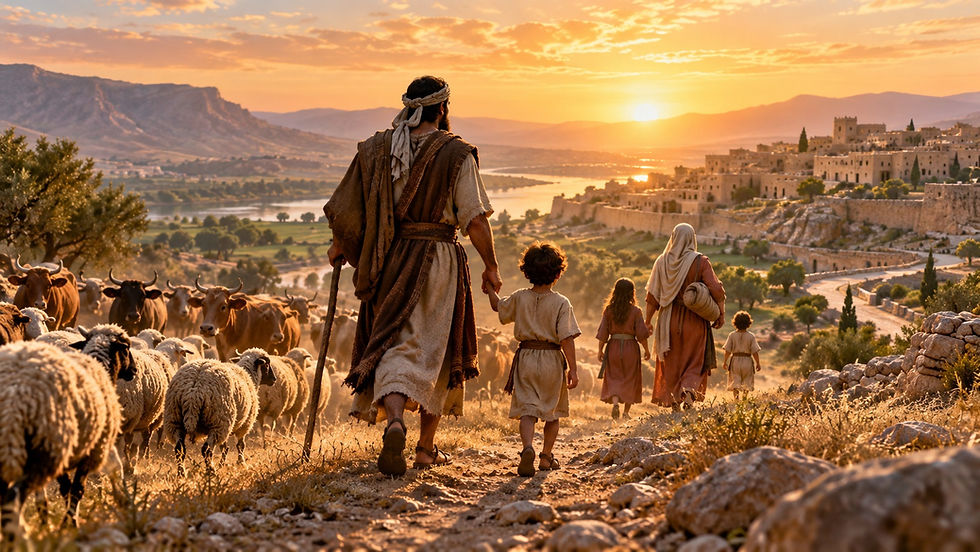
Then they reached the edge of the Promised Land.
The wilderness was behind them. Ahead was Canaan, a land of wheat and barley, vineyards and fig trees, pomegranates, olive oil, and honey. It was a land where they would build houses, cultivate fields, gather harvests, eat, and be satisfied.
At that threshold, the moment between scarcity and abundance, God gave them a warning wrapped inside a command.
Praise After the Blessing
Deuteronomy 8:10 says:
“When you have eaten and are satisfied, praise the Lord your God for the good land he has given you.”
The timing of this command matters. In this passage, God specifically tells His people to praise Him after they have eaten and are satisfied — when the need has been met, the table is full, and the danger of forgetting Him is especially great.
Need can make our dependence upon God easier to recognize. When the cupboard is empty and the future is uncertain, we often know exactly where to turn. But when the harvest comes in, the pantry is stocked, the bills are paid, and life feels stable, the human heart can begin to drift.
God knew this about His people.
Just a few verses later, Deuteronomy 8:12–14 warns:
“When you eat and are satisfied, when you build fine houses and settle down, and when your herds and flocks grow large and your silver and gold increase and all you have is multiplied, then your heart will become proud and you will forget the Lord your God, who brought you out of Egypt, out of the land of slavery.”
Prosperity can have a short memory. Abundance whispers a subtle lie — that the good things in our lives are solely the product of our own hands, effort, intelligence, or wisdom.
Slowly, gratitude can give way to entitlement. The gift begins to feel like a guarantee. The blessing begins to feel like a birthright. The God who provided it all moves from the center of our lives to the margins.
That is why God placed this command where He did. His people were not only to praise Him in the wilderness, where their dependence was obvious, but also in the abundance, where gratitude would require deliberate remembrance.
The land of milk and honey was never meant to replace God. It was meant to reveal His generosity and faithfulness. Yet, the only way to keep the blessing from becoming a barrier was to remember the One from whom it came — to eat, be satisfied, and praise the Lord.
Gratitude after satisfaction is not automatic. It is a discipline, and God commands it because He knows what can happen to the human heart when that discipline is abandoned.
Rooted and Overflowing
Paul expressed a similar principle when he wrote to the church at Colossae.
Colossians 2:6–7 says:
“So then, just as you received Christ Jesus as Lord, continue to live your lives in him, rooted and built up in him, strengthened in the faith as you were taught, and overflowing with thankfulness.”
One of the most important words in this passage is overflowing.
Paul did not describe gratitude as a small, occasional response offered only when circumstances are favorable. He pictured thankfulness as something abundant, spilling into our conversations, relationships, worship, and daily lives.
But Paul did not begin with the overflow. He began with the roots:
“Rooted and built up in him, strengthened in the faith.”
Christian gratitude does not come merely from trying harder to feel thankful. It grows from remaining deeply rooted in Christ.
A tree with deep roots can draw water during a dry season. In the same way, a life rooted in Christ can continue giving thanks even when circumstances are difficult, and not because pain is unreal, but because the source of our hope is deeper than our circumstances.
Israel’s history shows that visible miracles do not automatically produce lasting gratitude. Even while manna appeared each morning, the Israelites sometimes grumbled and struggled to trust God. Later, when the miraculous manna was replaced by the ordinary harvests of Canaan, the temptation to forget the Giver remained.
Their problem was not simply that they forgot to say thank you. Their hearts repeatedly struggled to remain faithful to the God who had delivered and sustained them.
Paul’s instruction addresses that deeper issue. Continue in Christ. Remain rooted in Him. Be built up in Him. Grow stronger in the faith.
As believers remain connected to Christ, thankfulness increasingly becomes the fruit of that relationship— not merely a forced religious exercise, but a practiced response to grace.
With All My Heart
David showed what wholehearted gratitude could look like.
Psalm 9:1 says:
“I will give thanks to you, Lord, with all my heart; I will tell of all your wonderful deeds.”
Two words stand out in this verse: all and all.
“All my heart” describes gratitude that is sincere rather than halfhearted. It is not merely the thankfulness that appears during a Sunday service and disappears by Monday afternoon. It is not gratitude that sounds right in prayer but never changes the way a person lives.
David is describing thankfulness that reaches the whole heart, one that is genuine, unreserved, and deeply personal.
Then comes the second “all”:
“I will tell of all your wonderful deeds.”
David’s gratitude did not remain only within him. It expressed itself through testimony. He remembered and declared the victories, rescues, provision, protection, mercy, and faithfulness of God.
Scripture frequently connects gratitude with testimony. A thankful heart often expresses itself by telling others what God has done. Gratitude may also appear through prayer, worship, generosity, obedience, service, and quiet faithfulness, but it should shape the way we live.
David’s songs of praise have encouraged countless people across generations. His gratitude continued speaking long after his earthly life ended. That is one of the beautiful results of expressed thankfulness: it can strengthen people we may never meet, in circumstances we may never see.
The Posture of Worship
Gratitude does not only shape how a person lives. It also shapes how a person worships.
Psalm 95:2–3 says:
“Let us come before him with thanksgiving and extol him with music and song. For the Lord is the great God, the great King above all gods.”
The psalmist describes thanksgiving as part of the posture we carry into God’s presence. We may come to God with requests, questions, grief, or lament. Scripture gives us permission to speak honestly with Him about every burden. But even amid those prayers, we can remember His character and approach Him with thanksgiving already on our lips.
A heart that comes with gratitude has begun by acknowledging who God is and what He has done. It is not only coming to receive, it is also coming to honor Him.
From that posture, worship deepens, faith strengthens, and perspective begins to realign.
The reason for this thanksgiving is clear:
“For the Lord is the great God, the great King above all gods.”
Gratitude grows from seeing God more clearly through His greatness, holiness, sovereignty, mercy, and authority over all creation.
When we remember who He is, thanksgiving becomes more than an obligation. It becomes a fitting response to His character.
The King who provides for His people, sustains them through hardship, protects them, forgives them, and leads them deserves more than occasional acknowledgment. He deserves a life marked by remembrance and praise.
Always Giving Thanks
Paul summarized the discipline of gratitude in Ephesians 5:20:
“Always giving thanks to God the Father for everything, in the name of our Lord Jesus Christ.”
This is gratitude as a way of life.
Paul’s words do not mean that believers must call evil good, pretend suffering is painless, or thank God for sin, abuse, injustice, or tragedy as though those things were desirable. Scripture gives us language for grief, lament, repentance, and righteous sorrow.
Rather, Paul calls believers to maintain a posture of thanksgiving in every circumstance. In abundance and scarcity, harvest and drought, celebration and grief, answered prayer and seasons of waiting, we can still thank God for His presence, His promises, His salvation, His mercy, and His unchanging character.
We may not understand the purpose behind every trial. Some questions may remain unanswered in this life. Gratitude does not require us to pretend that we understand everything.
It is an act of faith that says: I still believe God is good, even when I cannot see what He is doing.
This is what separates gratitude as a passing emotion from gratitude as a way of living.
Emotions often rise and fall with circumstances. A life of gratitude does not wait for the right feeling. It chooses to remember God and respond to Him faithfully.
Paul’s ministry included imprisonment, beatings, betrayal, hardship, opposition, and a persistent affliction that God did not remove. He did not teach gratitude from a life untouched by suffering.
Yet, his thankfulness was not destroyed by hardship because it was not built upon comfort. It was rooted in Christ.
Circumstances change. Christ does not.
What Shall I Return to the Lord?
All of this leads to a question, the question that every deeply grateful heart eventually asks.
Psalm 116:12–14 says:
“What shall I return to the Lord for all his goodness to me? I will lift up the cup of salvation and call on the name of the Lord. I will fulfill my vows to the Lord in the presence of all his people.”
“What shall I return to the Lord for all his goodness to me?”
It is the honest response of someone who has considered God’s provision, protection, grace, mercy, and salvation and realized that no gift could ever equal what has been received.
There is no offering large enough, no praise eloquent enough, and no human effort capable of repaying God for His goodness.
Yet, the psalmist’s response teaches us several ways gratitude can become visible.
First, gratitude receives and celebrates God’s salvation. We acknowledge that deliverance comes from Him and refuse to take credit for what only His grace could accomplish.
Second, gratitude continues calling upon the Lord. Our relationship with God does not end once a blessing is received. A grateful heart continues seeking Him, not only because of what He gives, but because God Himself is the greatest gift.
Third, gratitude produces faithfulness. When we make personal promises or commitments to God, we should take them seriously and seek to fulfill them with integrity. Gratitude is not merely something we feel in an emotional moment; it becomes visible through obedience, consistency, worship, service, generosity, and devotion.
This does not mean we can repay God or enter into a transaction with Him. His grace cannot be purchased or earned. Instead, a thankful life responds to grace by honoring God openly and faithfully.
We show gratitude by receiving what He gives, depending upon Him continually, keeping our commitments, sharing what He has done, serving others, worshiping sincerely, and using His blessings for His purposes.
The answer to “What shall I return?” is not a payment.
It is a life.
A life that receives God’s salvation, remains connected to Him, and responds to His goodness with faithful obedience.
That is what gratitude looks like when it moves beyond a feeling and becomes a way of living.
The Discipline That Changes Everything
The Israelites were commanded to praise God after they were satisfied because satisfaction is where gratitude can be easily lost.
Paul told the Colossians to remain rooted in Christ so that thankfulness would become the growing fruit of their faith. David gave thanks with his whole heart and allowed that gratitude to become testimony. The psalmist approached God with thanksgiving. Paul taught believers to give thanks in every circumstance.
The writer of Psalm 116 asked the question that sincere gratitude eventually asks:
“How should I respond to all the goodness God has shown me?”
The answer remains the same.
Receive what God has given. Stay connected to Him. Honor your commitments. Live faithfully before others. Use His blessings well. Never allow the gift to make you forget the Giver.
The wilderness taught Israel that they depended upon God. The Promised Land was meant to teach them that they must continue remembering and thanking Him.
The manna made their dependence unmistakable, even though they still sometimes complained. The harvest could more easily be mistaken for the product of human effort alone, even though the rain, soil, seed, strength, opportunity, and increase all came from God.
The blessings that appear to come from our own effort often require the most intentional gratitude. The moments when life feels fullest may be the moments when remembrance matters most.
When you have eaten and are satisfied, praise the Lord.
Rock/Water Apparel is named after a moment of impossible provision—God bringing water from a rock in the wilderness when His people had nothing (Exodus 17:6). Every design we create carries that story: in the driest places, God provides. And for that, we are grateful.
Visit us at rockwaterapparel.com and wear the mission.
God Provides.
Scripture quotations are from the New International Version (NIV).


Comments