
Through the Fire: How Faith Endures When Life Falls Apart

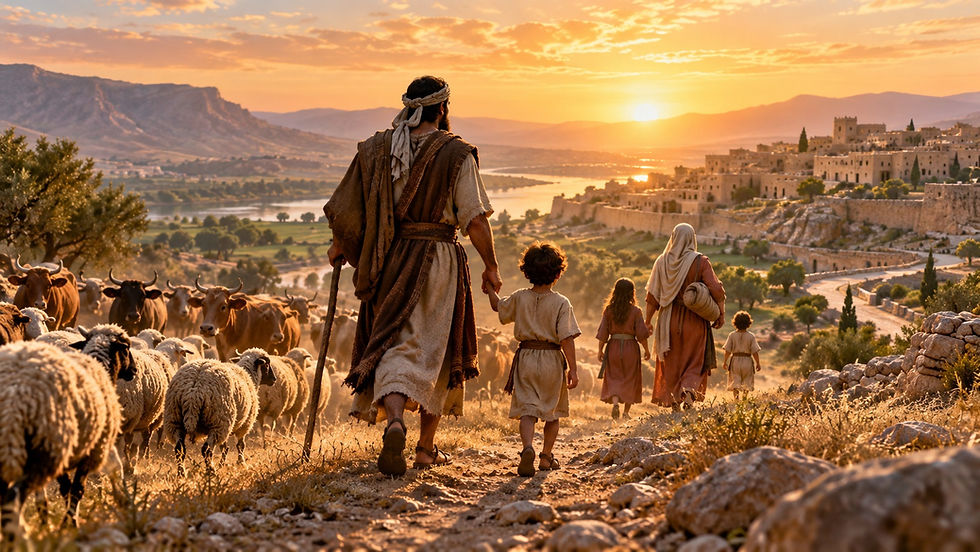
Job had nearly everything a man of his time could desire: seven sons, three daughters, vast herds, many servants, and a reputation as the greatest man in the East. More importantly, he feared God and lived with integrity. Spiritually, materially, and relationally, his life was full.
When Everything Is Taken
In the span of a single day, almost everything was taken from Job.
One messenger reported that raiders had stolen his oxen and donkeys and killed the servants tending them. Before that messenger finished speaking, another arrived to say that fire had fallen from the sky and consumed the sheep and their shepherds. Then came news that the Chaldeans had taken the camels and killed more servants.
Finally, the gravest message came: a great wind had struck the house where Job’s children were gathered, killing all ten of them.
Job tore his robe. He shaved his head. He fell to the ground.
And then he worshiped.
“The Lord gave and the Lord has taken away; may the name of the Lord be praised.” — Job 1:21
In the weeks and months that followed, painful sores covered Job from head to foot. His wife urged him to curse God and die. His closest friends sat with him silently for seven days, but then spent much of the following conversation insisting that his suffering must have been caused by some hidden sin.
Job grieved. He questioned. He protested. He demanded an audience with God. He did not receive a full explanation for why his suffering had happened. Yet through anguish, confusion, protest, and eventual correction, he continued turning toward God rather than finally walking away from Him.
Job’s story took place thousands of years ago, but the shape of suffering has not changed.
A father receives a phone call in the middle of an ordinary afternoon and learns that his wife’s scan brought devastating news. A mother sits in a hospital waiting room while her child is in surgery, watching the clock move more slowly than she thought possible. A man opens an email and discovers that the company he served for fifteen years has eliminated his position, and the mortgage is due in two weeks. A woman buries her husband at forty-three and returns to a house that still carries the traces of his presence.
Suffering rarely announces itself. It does not wait for a convenient time. It enters uninvited and rearranges everything: plans, expectations, routines, prayers, and assumptions about how life was supposed to unfold.
The question every person eventually faces is not whether suffering will come. The question is what happens to faith when it does.
Faith When Everything Fails
Habakkuk is one of the shortest books in the Old Testament. Tucked between Nahum and Zephaniah, it is easy to overlook. Yet, its closing verses contain one of Scripture’s most remarkable declarations of trust.
Habakkuk ministered in Judah during a dark and unstable period. The nation was facing judgment, invasion, and the collapse of the security his generation had known. God revealed that Babylon was coming, and Habakkuk could not prevent the crisis through his own strength.
His response was not denial. He did not pretend that everything would be fine. Instead, he acknowledged the full weight of what could be lost:
“Though the fig tree does not bud and there are no grapes on the vines, though the olive crop fails and the fields produce no food, though there are no sheep in the pen and no cattle in the stalls, yet I will rejoice in the Lord, I will be joyful in God my Savior.” - Habakkuk 3:17–18
Habakkuk listed the foundations of the agricultural economy: fruit, crops, sheep, and cattle. Every visible source of security could fail.
Then he said, “Yet.”
That single word carries the weight of the entire passage. Everything before it describes loss. Everything after it declares faith.
“Yet I will rejoice in the Lord.”
Habakkuk’s joy was not rooted in favorable circumstances. Had it been, it would have withered with the fig tree. His joy was rooted in God Himself and in who God is, not merely in what God gives. That kind of joy does not require a good day in order to survive. It endures because its source endures.
The apostle Paul understood suffering from another angle. He was beaten, imprisoned, shipwrecked, abandoned, stoned and left for dead, and afflicted by a persistent “thorn in the flesh” that God did not remove. His body bore the cost of his ministry, yet he wrote:
“Therefore we do not lose heart. Though outwardly we are wasting away, yet inwardly we are being renewed day by day. For our light and momentary troubles are achieving for us an eternal glory that far outweighs them all.” - 2 Corinthians 4:16–17
Paul called his troubles “light and momentary,” not because they were painless, but because he weighed them against something infinitely greater: eternal glory. He viewed suffering on a scale that included forever.
His body was weakening, but God was renewing him inwardly. His circumstances were unstable, but his eternal future was secure. His pain was real, but it was not ultimate. In the hands of God, the very trial that seems determined to destroy us can become the place where He forms something that suffering cannot take away.
Peter expressed a similar truth while writing to believers facing hostility, displacement, and pressure because of their faith:
“In all this you greatly rejoice, though now for a little while you may have had to suffer grief in all kinds of trials. These have come so that the proven genuineness of your faith—of greater worth than gold, which perishes even though refined by fire—may result in praise, glory and honor when Jesus Christ is revealed.” - 1 Peter 1:6–7
Gold is refined by fire. Heat reveals what is genuine and separates precious metal from impurity.
Trials can do something similar in the life of faith. They expose what we are truly resting on. They can strip away shallow assumptions, deepen dependence on God, and reveal that genuine faith remains anchored in Christ even when it is wounded, confused, or trembling.
The refining process is never comfortable. Faith that has passed through fire may carry scars. It may contain unanswered questions. It may not always feel strong.
But faith does not have to be loud in order to be genuine. Sometimes faith is simply the decision to keep turning toward God when every part of life hurts.
The writer of Hebrews says:
“You need to persevere so that when you have done the will of God, you will receive what he has promised.” - Hebrews 10:36
There is a promise beyond perseverance. It may not arrive as the earthly outcome we hoped for, and it does not operate on our timetable, but God’s final promises of salvation, resurrection, and eternal inheritance remain secure.
The road may be longer than expected, but the One who made the promise is faithful.
God’s Presence and Strength in Suffering
The Israelites stood at the edge of the Red Sea with Pharaoh’s army closing in behind them. Water blocked the way ahead. Their enemies approached from behind. No military strategy, escape route, or human solution remained. They were trapped.
Then God parted the sea.
The Israelites crossed on dry ground, with walls of water standing on either side. They emerged alive and free, while the waters closed over the army that had pursued them.
Centuries later, Shadrach, Meshach, and Abednego were thrown into a furnace heated so intensely that the soldiers who cast them in were killed by the flames. The fire was meant to destroy them. But when the king looked into the furnace, he saw four figures walking in the flames. The three men were unbound and unharmed, and the fourth appeared “like a son of the gods.”
They were not spared from entering the fire. They encountered God in the middle of it.
Isaiah captures the faithfulness of God in words originally spoken to His covenant people:
“When you pass through the waters, I will be with you; and when you pass through the rivers, they will not sweep over you. When you walk through the fire, you will not be burned; the flames will not set you ablaze.” - Isaiah 43:2
God did not promise His people a life without waters, rivers, or fire. He promised that suffering would not separate them from His covenant faithfulness or defeat His saving purpose.
This passage should not be treated as a guarantee that believers will never experience physical harm. Scripture records faithful people who were imprisoned, beaten, persecuted, and killed. Earthly deliverance does not always come in the form we desire, but suffering does not have the final word.
Shadrach, Meshach, and Abednego faced the terror of the furnace. The Israelites heard Pharaoh’s chariots approaching. The danger, fear, and helplessness were real.
But so was the presence of God.
God’s help does not always look like immediate removal. Sometimes it looks like strength to endure what has not yet been removed.
Isaiah writes:
“He gives strength to the wearyand increases the power of the weak. Even youths grow tired and weary, and young men stumble and fall; but those who hope in the Lord will renew their strength. They will soar on wings like eagles; they will run and not grow weary, they will walk and not be faint.” - Isaiah 40:29–31
Human strength has limits. Even the young become tired. The disciplined reach exhaustion. The resilient eventually discover that determination alone cannot sustain them forever. That is often where we become especially aware of God’s strength.
His power is not merely an extra reserve added to our own. It is the sustaining grace beneath every faithful step, including the steps we can no longer take without His help.
An eagle cannot rise indefinitely through its own effort. It spreads its wings and is carried by currents stronger than itself. In a similar way, hope in the Lord connects us to strength that does not originate within us and therefore does not disappear when our own resources are exhausted.
Elijah experienced this after the victory on Mount Carmel. He had witnessed fire fall from heaven and the defeat of the prophets of Baal. Yet after Jezebel threatened his life, he fled into the wilderness, collapsed beneath a tree, and asked God to let him die.
One of Israel’s greatest prophets, immediately following an extraordinary spiritual victory, became so exhausted and afraid that he wanted his life to end.
God first met Elijah’s exhaustion with food, water, and sleep. He sent an angel to feed him. He allowed Elijah to rest. He fed him again. Only afterward did God question him, reveal His presence, correct his sense of isolation, and give him a renewed assignment.
God did not ignore Elijah’s physical condition while addressing his spiritual condition.
Sometimes God’s care appears through very ordinary gifts: food, sleep, medicine, wise counsel, community, silence, and the presence of someone willing to sit beside us. Receiving such help is not spiritual failure. It may be one of the ways God sustains us.
Jesus extends an invitation to everyone carrying burdens too heavy to bear alone:
“Come to me, all you who are weary and burdened, and I will give you rest. Take my yoke upon you and learn from me, for I am gentle and humble in heart, and you will find rest for your souls. For my yoke is easy and my burden is light.” - Matthew 11:28–30
When Jesus says, “Take my yoke upon you and learn from me,” He is inviting the weary to come under His gracious rule and become His disciples.
His yoke still involves obedience, surrender, and learning. Following Christ is not a life without responsibility. But unlike the crushing burdens imposed by sin, fear, self-righteous striving, and human expectations, His leadership gives rest to the soul.
Jesus does not merely hand us another burden and leave us to carry it alone. He welcomes us into a life sustained by His grace.
And He is gentle. He does not shame the exhausted for being tired. He does not despise those who come to Him with questions, grief, and little strength remaining. He is gentle and humble in heart.
He meets us where we are and teaches us to walk with Him from there.
What God Produces Through Trials
Paul wrote to the church in Rome:
“Not only so, but we also glory in our sufferings, because we know that suffering produces perseverance; perseverance, character; and character, hope. And hope does not put us to shame, because God’s love has been poured out into our hearts through the Holy Spirit, who has been given to us.” - Romans 5:3–5
Paul describes a chain of spiritual formation. Suffering can produce perseverance as believers continue trusting God under pressure. Perseverance produces tested character. Tested character deepens hope.
This is not shallow optimism, the assumption that everything will quickly become easy. It is battle-tested confidence rooted in the love of God and the presence of the Holy Spirit.
It says:
God has been faithful before.
God is faithful now.
God will remain faithful, even when I cannot yet see what He is doing.
Suffering is not the only way God forms hope. Hope comes through Scripture, worship, Christian community, the resurrection of Christ, and the work of the Holy Spirit.
But suffering is one of the places where hope is tested, strengthened, and made deeply personal.
Joseph understood this kind of formation. His brothers sold him into slavery when he was seventeen. He was taken to Egypt, separated from his family, falsely accused by his master’s wife, and imprisoned unjustly. He remained confined for years and was eventually forgotten by the cupbearer whose dream he had interpreted.
Yet Genesis repeatedly tells us that God was with Joseph.
Those years appear to have deepened the wisdom, endurance, humility, and dependence on God that he would later need when entrusted with authority. When Joseph finally stood before Pharaoh and interpreted the dreams no one else could explain, he was prepared to help lead Egypt through seven years of famine.
Years later, when his brothers feared that he would take revenge, Joseph told them:
“You intended to harm me, but God intended it for good to accomplish what is now being done, the saving of many lives.” - Genesis 50:20
Joseph did not call evil good. His brothers’ actions were still betrayal. The false accusation was still unjust. The prison years were still painful.
But human evil could not overthrow God’s purpose.
God did not waste Joseph’s suffering. He worked through what others intended for harm and brought about preservation, reconciliation, and life.
Not every hardship is God’s discipline, and Scripture does not permit us to assume that every tragedy is punishment for personal sin.
However, Hebrews teaches that when God does discipline His children, His purpose is not destruction but formation:
“No discipline seems pleasant at the time, but painful. Later on, however, it produces a harvest of righteousness and peace for those who have been trained by it.” - Hebrews 12:11
“Later on.” Those words require faith.
In the moment, pain often feels like nothing more than pain. We may have no clarity, perspective, or ability to see what God is forming. But in His time, loving discipline can produce righteousness and peace in those who submit to His training.
James adds another promise:
“Blessed is the one who perseveres under trial because, having stood the test, that person will receive the crown of life that the Lord has promised to those who love him.” - James 1:12
The crown of life is not payment for raw human toughness. It is God’s promised gift to those who love Him and whose enduring faith is revealed through trial.
Perseverance does not earn salvation. Salvation is a gift of grace. But persevering faith demonstrates that our hope is rooted in the One who holds us, even when our grip feels weak.
God’s Promises
Every story of endurance, every passage about fire and water, and every account of faith under pressure leads us back to the promises of God.
Jesus’ closing words in Matthew’s Gospel joined a commission with a promise. He sent His followers to make disciples, baptize, and teach. Then He assured them they would never carry out that mission alone:
“And surely I am with you always, to the very end of the age.” - Matthew 28:20
Always.
Not only when faith feels strong.
Not only when prayers are answered in the way we hoped.
Not only when life makes sense.
Always.
To everyone who belongs to Christ: God is with you. He has not abandoned you, and He will remain faithful to the very end.
That promise held true for Job, who lost nearly everything and discovered that God was still present. It held true for Habakkuk, who faced national disaster and declared, “Yet I will rejoice.”
It held true for Paul, whose body weakened while God renewed him inwardly.
It held true for Joseph, who spent years unjustly imprisoned and later saw God bring good from what others intended for evil.
It held true for Shadrach, Meshach, and Abednego, who entered the furnace and found that they were not alone.
And it holds true for the mother in the waiting room. The father staring at the diagnosis. The widow driving home alone. The man who lost his job and does not know how to tell his family. The believer whose prayer has not been answered as expected. The person who feels exhausted, confused, or barely able to hold on.
God sees.
God hears.
God remains faithful.
His presence does not mean every earthly story ends exactly as we desire. Some healing comes in this life. Some deliverance arrives unexpectedly. Some losses remain with us until resurrection.
But beyond the suffering, beyond the tears, beyond the final breath and last goodbye, God has made a promise that gives meaning to every other promise:
“He will wipe every tear from their eyes. There will be no more death or mourning or crying or pain, for the old order of things has passed away.” - Revelation 21:4
No more death.
No more mourning.
No more crying.
No more pain.
Not reduced.
Not managed.
Not merely made easier to endure.
Gone.
The old order will pass away and be replaced by a new creation in which the things that broke our hearts no longer exist.
God does not only promise to walk with us through the fire. He promises a day when suffering itself will be gone. He does not only promise comfort in grief. He promises a day when death, mourning, crying, and pain will be no more.
Every tear you have cried, He has seen. Every night you have wondered whether morning would ever come, He was present. Every prayer that seemed to strike the ceiling and fall back unheard was heard, even when His answer was delayed, different from what you pleaded for, or hidden from your understanding.
One day, not merely as a metaphor or symbol, but in the fullness of reality, God will wipe every last tear from the eyes of His people. The old order of suffering, loss, and death will pass away forever.
That is the promise.
And the God who made it is faithful.
Rock/Water Apparel is named after one of God’s powerful acts of provision — bringing water from a rock in the wilderness when His people had nothing left.
In seasons of suffering and in places that appear impossible, God remains faithful. He sustains His people, walks with them through the fire, carries them through the waters, and promises a day when every tear will be wiped away.
Visit Rock/Water Apparel and wear the mission.
God Provides.


Comments