
The Wall Falls One Stone at a Time

Drive through old farm country and you'll pass them without noticing — dry-stone walls running along the edge of a field, laid by hand a century or more ago. No mortar. Just stone set on stone by someone who understood how weight works.
Most of them are still standing. But look closely and you'll find sections that have given way, and if you ask a farmer how it happened he probably won't tell you about one catastrophic storm.
Walls like that rarely come down all at once.
Frost gets into a seam. One stone shifts an inch. The next season another follows. The stone above it loses its seat. For years, nothing looks wrong to anyone driving past.
Then one morning there's a gap you could walk a horse through, the animals are in the road, and it is impossible to say exactly when it happened.
That is often how it goes in a home, too. Not with a crisis. With a Tuesday.
With a question at bedtime that you don't have an answer for, so you say we'll talk about it later, and you mean it, but later doesn't come. With a season of missed Sundays that started for a good reason. With a habit of talking about everything at the dinner table except the one thing you'd say matters most.
None of it feels like collapse. Each one is a single stone. The good news is that walls are also rebuilt the same way.
One stone at a time, by people who decided to start.
A Tool in One Hand
There's a moment in Nehemiah 4 that gets to the heart of this better than almost anything else in Scripture.
Nehemiah has come back to Jerusalem to rebuild a wall that has been broken for generations. The work is moving forward, and opposition shows up. There is mockery first, then threats.
The workers are tired. The rubble is enormous. The danger is real.
And when Nehemiah rallies them, he is completely specific about what all of it is for.
After I looked things over, I stood up and said to the nobles, the officials and the rest of the people, “Don’t be afraid of them. Remember the Lord, who is great and awesome, and fight for your families, your sons and your daughters, your wives and your homes.” - Nehemiah 4:14
Notice what that sentence is aimed at.
Brothers.
Sons and daughters.
Wives.
Homes.
Nehemiah is not telling the people to go looking for a fight. He is telling them what is worth protecting.
Whatever the word defend means in the Christian life, it should begin there: standing faithfully in front of something entrusted to you rather than looking for someone to attack.
Then comes the picture everybody remembers.
Those who carried materials did their work with one hand and held a weapon in the other, and each of the builders wore his sword at his side as he worked. - Nehemiah 4:17–18
Read it carefully, because it's easy to romanticize.
They did not stop being builders in order to become conquerors. Some worked while others stood armed, and even those doing the work remained prepared to defend it.
The wall was still the point. The weapons served the rebuilding effort. They were never the purpose of it.
That's the posture this whole post is about.
What Guarding the Faith Actually Looks Like
If you grew up hearing sermons about spiritual warfare, you may have absorbed a picture that Scripture itself complicates.
The New Testament does not pretend there is no battle. It tells us something harder: to recognize the right enemy.
Paul writes that our struggle is not against flesh and blood.
For our struggle is not against flesh and blood, but against the rulers, against the authorities, against the powers of this dark world and against the spiritual forces of evil in the heavenly realms. - Ephesians 6:12
That matters.
The person across from you is not the enemy. The teenager asking a difficult question is not the enemy. The neighbor who disagrees with you is not the enemy. The person arguing with you online is not the enemy.
The New Testament repeatedly tells Christians to stand, guard, hold firmly, keep watch, resist, contend and be prepared.
Those are serious words. But they do not give us permission to turn people into targets.
Peter's instruction is the one most of us know.
But in your hearts revere Christ as Lord. Always be prepared to give an answer to everyone who asks you to give the reason for the hope that you have. But do this with gentleness and respect - 1 Peter 3:15
It's a call to be able to explain yourself — which assumes you have thought about what you believe, which assumes you know what you believe and why.
But look at where the sentence goes.
With gentleness and respect.
That isn't a softener tacked on at the end. It carries the same weight as be prepared. A defense of the faith delivered with contempt has failed the instruction even if every fact in it is correct.
Peter is describing a person who can be questioned without becoming hostile — which, in a home, is exactly the kind of person a teenager will risk asking a hard question.
Paul stacks four imperatives into a single line.
Be on your guard; stand firm in the faith; be courageous; be strong. - 1 Corinthians 16:13
Every one of those commands is about faithfulness under pressure.
Be on your guard.
Stand firm.
Be courageous.
Be strong.
Paul isn't telling the Corinthians to overpower their neighbors. He's telling them not to surrender their footing.
Courage here is the courage to still be standing there in the morning.
To Titus, Paul puts it in terms of grip.
He must hold firmly to the trustworthy message as it has been taught, so that he can encourage others by sound doctrine and refute those who oppose it. - Titus 1:9
Hold firmly.
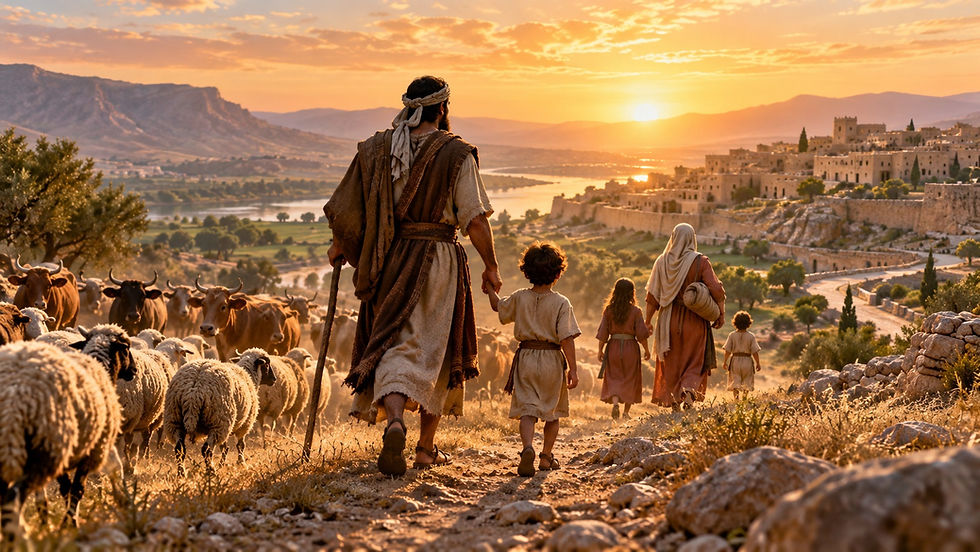
The way you hold a rope. Or a child's hand in a crowd.
And notice why. Holding firmly isn't only about answering contradiction. It equips a leader to encourage others with sound doctrine as well.
Much of what a steady faith produces is not argument at all. It's the stability other people borrow from you.
Then there's Paul's warning to the Ephesian elders, which is the one that should keep us humble.
Keep watch over yourselves and all the flock of which the Holy Spirit has made you overseers. Be shepherds of the church of God, which he bought with his own blood. I know that after I leave, savage wolves will come in among you and will not spare the flock. Even from your own number men will arise and distort the truth in order to draw away disciples after them. So be on your guard! - Acts 20:28–31
Two things in there are worth slowing down for. The first is the direction of the threat. The wolves come in among them. Paul even warns that some will arise from within their own number and distort the truth. That's a far less comfortable danger to watch for than one you can point at across a border.
The second is the order. Before Paul says a word about the flock, he tells them to keep watch over themselves. It's tempting to think of guarding the faith as monitoring the culture — tracking what's happening out there, staying alarmed, watching everyone else.
Paul starts somewhere much closer. Watch yourself first. Then the people in your care.
The perimeter you are actually responsible for is a lot smaller than the internet. And a lot harder.
It Starts at Your Own Table
Which brings us to the place all of this actually lives.
Joshua's line is the one people put on their wall, and it deserves the space.
But as for me and my household, we will serve the Lord. - Joshua 24:15
What's easy to miss is the setting.
Joshua says it near the end of his life, in front of the people, after laying out the alternatives and telling them to choose whom they will serve.
He isn't announcing a mood. He is declaring, publicly and unmistakably, the allegiance that will define his household.
It's a commitment.
Deuteronomy 6 tells you what that commitment looks like on an ordinary weekday.
Hear, O Israel: The Lord our God, the Lord is one. Love the Lord your God with all your heart and with all your soul and with all your strength. These commandments that I give you today are to be on your hearts. Impress them on your children. Talk about them when you sit at home and when you walk along the road, when you lie down and when you get up. Tie them as symbols on your hands and bind them on your foreheads. Write them on the doorframes of your houses and on your gates. - Deuteronomy 6:4–9
It begins with the whole of it — heart, soul, strength — and then says these words are to be on your heart first.
Not your children's. Yours. You cannot impress on a child something you are not carrying yourself.
Then it gets almost comically practical.
When you sit at home.
When you walk along the road.
When you lie down.
When you get up.
That's bigger than a curriculum.
It's a description of a house where the subject simply comes up — in the car, at the sink, at bedtime, on the way out the door.
Faith is not confined to one hour on Sunday. It's woven into ordinary life. And the doorframe is not decoration. It's a reminder placed where you can't avoid seeing it.
Whatever is written on your doorframes — literally or otherwise — is what your children will eventually assume the house is about.
Paul gives fathers the short version.
Fathers, do not exasperate your children; instead, bring them up in the training and instruction of the Lord. - Ephesians 6:4
Notice how the verse begins. Do not exasperate your children. Only then does Paul turn to their training and instruction.
He refuses to separate what parents teach from the way they treat the child they are teaching. The manner of instruction matters alongside its content.
Psalm 78 gives the reason none of this can be skipped.
We will not hide them from their descendants; we will tell the next generation the praiseworthy deeds of the Lord, his power, and the wonders he has done. He decreed statutes for Jacob and established the law in Israel, which he commanded our ancestors to teach their children, so the next generation would know them, even the children yet to be born, and they in turn would tell their children. Then they would put their trust in God and would not forget his deeds but would keep his commands. - Psalm 78:4–7
Read the chain of it. One generation tells the next so that they in turn will tell theirs, so that a child not yet born will someday put their trust in God. The psalm is thinking generations ahead.
It assumes that truth is handed down. Received. Remembered. Told again.
What one generation refuses to hand over, the next generation cannot pass on in quite the same way.
And Proverbs gives parents a wisdom principle worth holding onto.
Start children off on the way they should go, and even when they are old they will not turn from it. - Proverbs 22:6
Train is the word. Not merely lecture. Not merely inform.
Training is the slow, repetitive, mostly unremarkable work of forming habits over time — doing something faithfully enough that it begins to shape the way a person walks through life.
That proverb is not a mechanical guarantee that every child raised well will make every right choice. Scripture gives us too many examples of human freedom, rebellion and heartbreak to read it that way. But it does tell us something important about formation.
Direction matters.
Habits matter.
What is practiced matters.
The stones you place matter.
What Holds and What Doesn't
Jesus ends the Sermon on the Mount with two houses and one storm.
Therefore everyone who hears these words of mine and puts them into practice is like a wise man who built his house on the rock. The rain came down, the streams rose, and the winds blew and beat against that house; yet it did not fall, because it had its foundation on the rock. But everyone who hears these words of mine and does not put them into practice is like a foolish man who built his house on sand. The rain came down, the streams rose, and the winds blew and beat against that house, and it fell with a great crash. - Matthew 7:24–27
Both men build. Both houses take the weather. That's the part people skip.
The rain, the streams and the wind come against both of them. The difference isn't the storm. And it isn't whether either man heard Jesus' words. Both did.
The difference is what hearing became. One heard and acted. The other heard and did not. The foundation showed itself when the weather arrived.
The psalmist says something related in one line.
Unless the Lord builds the house, the builders labor in vain. Unless the Lord watches over the city, the guards stand watch in vain. - Psalm 127:1
That's not an argument against working hard. It's a warning against mistaking hard work for self-sufficiency.
You can exhaust yourself building.
You can exhaust yourself guarding.
You can exhaust yourself providing.
But effort alone cannot make a house secure.
If the Lord is absent from what you're building, the builder's labor cannot substitute for him.
That lands just as squarely on the man putting in eighty hours a week to provide for his family as it does on anyone else.
Providing matters.
Working matters.
Building matters.
But the Builder matters more.
Proverbs adds the mechanics.
By wisdom a house is built, and through understanding it is established; through knowledge its rooms are filled with rare and beautiful treasures. - Proverbs 24:3–4
Built by wisdom. Established through understanding. Filled through knowledge.
There is an order to that. A house needs more than contents. It needs something underneath it.
Start with One Stone
Jude sat down to write a warm letter about the salvation believers share and found himself writing about something more urgent.
Dear friends, although I was very eager to write to you about the salvation we share, I felt compelled to write and urge you to contend for the faith that was once for all entrusted to God’s holy people. - Jude 3
Contend is a strong word. And it should be. Christian faithfulness is not passive. But look at what's being contended for.
Something entrusted.
Something received.
Something handed down.
Something that belongs to God before it belongs to us.
The picture isn't conquest. It's custody. You were handed something precious.
Keep it.
Live it.
Hand it on.
Peter closes his letter with similar seriousness.
Be alert and of sober mind. Your enemy the devil prowls around like a roaring lion looking for someone to devour. Resist him, standing firm in the faith, because you know that the family of believers throughout the world is undergoing the same kind of sufferings. - 1 Peter 5:8–9
Be alert. The adversary prowls. And then the instruction:
Resist him.
Standing firm in the faith.
That is a very different picture from treating everyone who disagrees with you like an enemy.
Standing firm does not require advancing on your neighbor. It does not require winning the comment section. It does not require being the loudest person in the room.
Sometimes faithfulness looks far less dramatic. It looks like still being there when the weather clears.
Still believing.
Still praying.
Still teaching.
Still listening.
Still willing to answer.
Still holding the hand that was entrusted to you.
So here's the ask, and it's small on purpose.
Pick one stone this week. One.
Maybe it's answering the question your kid asked six months ago that you never came back to.
Maybe it's the first honest conversation at the dinner table in a while.
Maybe it's opening Scripture together once this week instead of waiting until you have a perfect family devotional plan.
Maybe it's finally learning why you believe what you believe, so that when you're asked you have something better than that's just how I was raised.
Maybe it's apologizing for the way you answered the last hard question.
Maybe it's writing something on your doorframe.
The wall came down one stone at a time. It goes back up the same way.
Nehemiah's crew rebuilt Jerusalem's wall with the rubble still enormous and the threats still real. And they finished it in fifty-two days.
So the wall was completed on the twenty-fifth of Elul, in fifty-two days. - Nehemiah 6:15
You are not being asked to fight everyone. You are being asked to be faithful with what God has placed in your care.
To build.
To guard.
To teach.
To listen.
To contend when necessary.
To resist what actually threatens the faith.
And when the pressure comes, to stand.
One stone at a time.
Rock/Water Apparel is named after one of God's most unlikely acts of provision—water from a rock in the wilderness (Exodus 17:6). In the hardest places, God provides. And sometimes what He provides is exactly what your heart needs most: a reason to laugh.
Visit us at rockwaterapparel.com and wear the mission.
God Provides.
Scripture quotations taken from The Holy Bible, New International Version® NIV® Copyright © 1973, 1978, 1984, 2011 by Biblica, Inc.™ Used by permission. All rights reserved worldwide.


Comments